


If an AED can be retrieved and brought to a person within approximately two minutes—allowing the first shock to be delivered within three minutes—then one AED may be sufficient.
However, if parts of the site cannot be reached within that timeframe, additional AEDs will be required.
During sudden cardiac arrest, the heart may stop pumping blood effectively without warning. CPR can help maintain blood flow, but an AED is required to analyse the heart rhythm and deliver a shock when needed.
The goal should be a “drop-to-shock” time of no more than three minutes.
This means considering the complete journey:
An AED that is technically “nearby” may still be too far away once doors, stairs, lifts, security checkpoints and the return journey are considered.
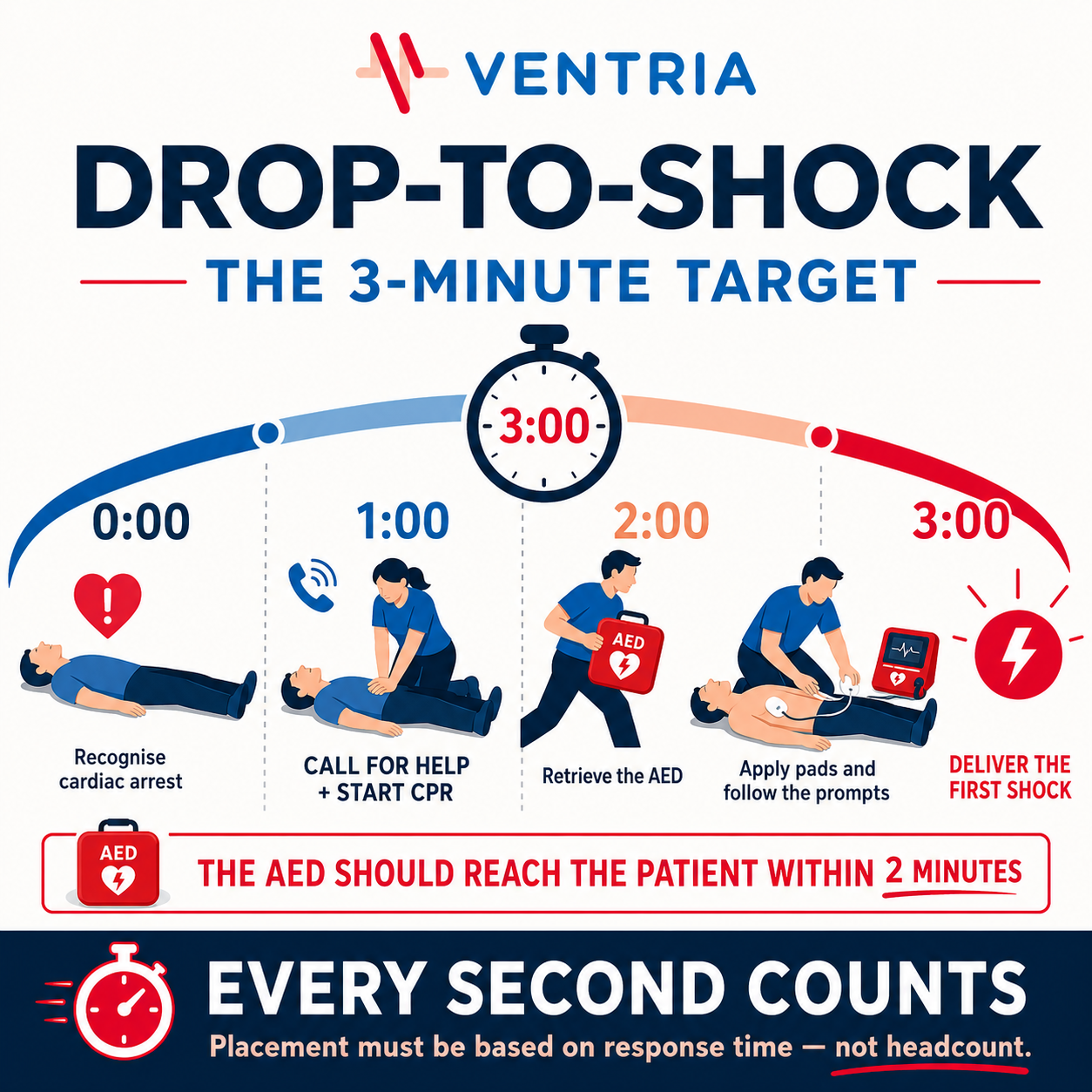
There is no single formula that applies to every workplace.
A single-storey office with 3,000 employees may need fewer AEDs than a multi-storey facility with only 500 people. Building layout, operating hours and access restrictions are often more important than staff numbers.
A proper AED site assessment should consider:
One of the simplest assessment methods is to walk the site with a stopwatch. Start from the areas furthest from the proposed AED location, retrieve the device and return to the simulated patient. The timing should reflect real working conditions—not an empty building with every door already open.
Research into out-of-hospital cardiac arrest in high-rise buildings demonstrates the impact that access delays can have on survival.
A study involving 7,842 cardiac arrests found that survival to hospital discharge was higher for incidents occurring below the third floor than for those on the third floor or above—4.2% compared with 2.6%. Survival was only 0.9% above the 16th floor, with no survivors recorded above the 25th floor in the study.
The researchers identified delays associated with reaching patients on higher floors and concluded that measures aimed at shortening the time to treatment could improve survival. While this study examined residential buildings, the access challenges are equally relevant when assessing multi-storey offices, hotels and other large facilities. Read the published study.
This does not necessarily mean placing an AED on every floor. It means testing whether your emergency response team can reach every part of the building quickly enough.

AEDs should generally be positioned:
The AED should be easy to see, easy to reach and available to the people who may need to use it. Placing it out of sight to keep it “safe” can waste critical time.
The correct question is not:
“How many people do we have?”
It is:
“Can we get an AED to anyone, anywhere on our site, quickly enough to make a difference?”
That is why every AED programme should begin with a proper site assessment. Correct placement can reduce response time, improve accessibility and ensure that the number of AEDs onsite is based on the realities of the facility—not a generic formula.
When sudden cardiac arrest happens, the best AED is the one that can reach the patient in time.
References:

